

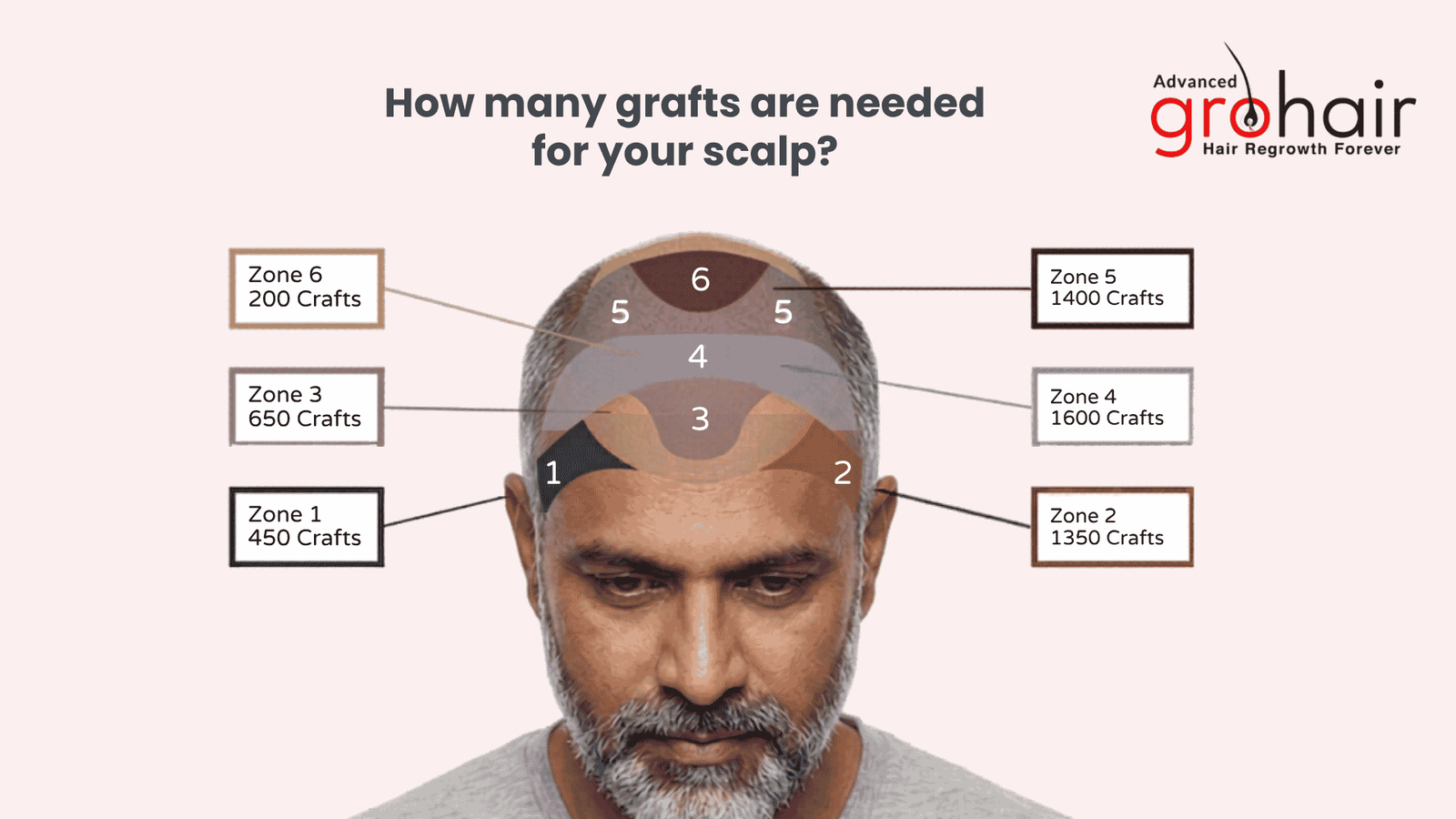
If you are considering a hair transplant, one of the first questions you will ask is, “How many grafts will restore my hairline?” or more importantly, “How many grafts will restore my confidence?”
It depends entirely on your current hair loss stage, donor area quality, scalp condition, and long-term goals. Minor recession may need only 1000 grafts, while advanced baldness may require 6000 grafts across multiple sessions.
In this guide, we explain the science behind every graft, how surgeons calculate, and what determines the total number of grafts required for a natural-looking and permanent hair restoration.
What Is a Hair Graft? Hairs vs Grafts Explained
A hair graft is a small piece of living tissue extracted during a hair transplant. More specifically, a hair graft is a small grouping of follicles taken from the scalp and implanted into areas affected by hair loss.
One hair transplant graft does not equal a single hair. In reality, a single graft may contain 1 to 4 hair follicles
Some grafts may even contain one to four hair follicles, depending on genetics and donor quality.
This means the number of hair grafts implanted creates significantly more individual hairs, improving hair density, overall scalp coverage, cosmetic fullness, and natural hair growth.
For example, 3000 grafts may yield 6000 to 9000 individual hairs.
Understanding the difference between hairs and grafts is essential when calculating how many hair grafts are necessary for a successful transplant.
Key Factors That Determine the Number of Hair Grafts Needed
Several variables help surgeons determine the number of grafts required for effective hair restoration.
Severity and Extent of Hair Loss
The extent of hair loss is the most important factor.
Patients with:
- Mild recession
- Early hair thinning
- Temple loss
need fewer grafts compared to patients with:
- Crown baldness
- Frontal baldness
- Extensive hair loss
- Severe diffuse thinning
Larger areas of hair loss automatically increase the number of grafts needed. Your current stage of hair loss directly affects how many grafts are needed.
Hair Type and Hair Characteristics
Your hair type and natural hair characteristics greatly influence graft planning.
Patients with:
- Thick hair
- Dense donor hair
- Curly hair
often require fewer grafts for cosmetic coverage.
Patients with:
- Fine hair
- Thin shafts
- Straight hair
usually need a higher density because the scalp becomes more visible. This is why two patients with identical baldness patterns may require completely different graft counts.
Donor Area Capacity
The availability of hair at the back and sides of the scalp is critical.
Surgeons assess:
- Donor density
- Scalp laxity
- Existing donor strength
- Quality of follicles
Patients must have enough healthy, strong hair follicles and sufficient hair in the donor area before surgery.
The quality of grafts in the donor area determines how many grafts are available.
Density Goals
Some patients want conservative restoration, while others want aggressive density.
Surgeons calculate grafts per square centimetre, Frontal density, Crown density and hairline softness.
The desired appearance helps determine the final graft number and total number of grafts required.
The Norwood Scale: Calculating How Many Hair Grafts You Need
The Norwood Scale is the medical standard used to classify male pattern baldness and estimate the average number of grafts required.
|
Norwood Stage |
Description of Hair Loss Pattern |
Average Number of Grafts Estimated |
|
Stage 2 |
Minor recession in the temple areas |
500 – 1,000 hair grafts |
|
Stage 3 |
Deepening “M” shape hairline; early hair thinning |
1,000 – 1,500 grafts needed |
|
Stage 4 |
Significant recession at the front; early thinning at the crown |
1,500 – 2,500 grafts required |
|
Stage 5 |
Large areas of hair loss; the bridge separating the front and back thins |
2,500 – 3,500 grafts will be required |
|
Stage 6 & 7 |
Severe hair loss; the bridge is completely gone |
4,000 – 5,000+ grafts to achieve full hair |
The Norwood Scale helps surgeons estimate:
- How many grafts are needed
- Total donor demand
- Future hair loss pattern
- Long-term restoration strategy
Patients often ask, “How many grafts do I need?” The answer depends entirely on the stage of baldness and donor capacity.
Early intervention offers the best opportunity to preserve donor reserves before severe hair loss develops.
Female Hair Transplant: Calculating Grafts for Women
Female hair loss differs significantly from male baldness.
Women usually experience:
- Diffuse thinning
- Widening part lines
- Reduced density
rather than an aggressive recession.
A female hair transplant focuses heavily on preserving existing hair while increasing density strategically. Most women require 1000, 1500, or 2500 grafts, depending on severity
Because surgeons must place grafts carefully between native hairs, the number of hair grafts needed can be more difficult to predict.
The Age Factor: Why Age Changes Graft Planning
Age is a major factor when planning a hair transplant surgery.
Patients in their early 20s may continue losing native hair aggressively over time. If too many grafts are used early, future procedures become difficult.
This is why surgeons take a conservative approach with younger patients.
Patients in their 30s, 40s and 50s typically have a more predictable hair loss trajectory, making it easier to calculate the final graft requirement.
Planning must always account for future baldness progression.
Can I Get 6000 Hair Grafts in One Procedure?
Patients with advanced baldness often ask whether 6000 hair grafts or even 6000 grafts can be performed safely in one session.
Technically, large sessions are possible, but most reputable hair restoration surgeons avoid excessive extraction in a single sitting.
Too many grafts in one procedure can:
- Reduce survival rates
- Damage donor hair
- Increase scalp trauma
- Affects blood circulation
Most surgeons limit extraction because grafts may remain outside the body too long during implantation.
If more coverage is needed, the surgeon may divide the hair transplant procedures into multiple sessions.
Risks of Getting the Graft Number Wrong
Overestimating Grafts
Extracting too many grafts can cause:
- Donor depletion
- Scarring
- Patchy appearance
- Unnatural results
Too many grafts harvested aggressively may permanently weaken the donor zone.
Underestimating Grafts
Using too few grafts can lead to:
- Poor density
- Inadequate coverage
- Unsatisfactory cosmetic improvement
This may require future corrective surgery.
Why Conservative Planning Matters
A skilled hair transplant surgeon understands that future hair loss continues progressing. Proper planning preserves Donor reserves, Long-term balance, and natural appearance.
When it comes to grafts per square centimetre, higher density is not always safer. Packing too many grafts tightly can reduce the blood supply and compromise survival.
Natural Density Expectations: What Is Realistically Achievable?
A natural scalp contains approximately 80 to 100 follicular units per square centimetre. However, a successful hair transplant generally involves 40 to 50 grafts per square centimetre.
Fortunately, patients do not need full native density to create the appearance of full hair. Due to layering and overlap, even 50% restored density creates excellent cosmetic fullness.
This is why proper placement matters more than simply increasing graft counts.
FUE vs FUT: Does the Hair Transplant Procedure Matter?
FUE Hair Transplant
An FUE hair transplant involves extracting follicles individually from the donor scalp.
Benefits include:
- Faster healing
- Minimal scarring
- Better recovery
- Flexible extraction
The FUE hair transplant procedure is especially popular for patients preferring shorter recoveries.
FUT Hair Transplant
FUT Hair Transplant removes a strip of scalp tissue containing follicles.
Benefits include:
- Higher graft yield
- Efficient harvesting
- Strong survival rates
Regardless of the method, the grafts to achieve successful hair restoration must be implanted carefully.
Knowing how many grafts you need helps surgeons plan the entire hair transplantation process effectively.
Graft Survival and Growth Timeline
The number of grafts means nothing if survival rates are poor.
A quality clinic typically achieves the 90% to 95% graft survival.
After surgery:
- Shock shedding occurs between weeks 2 and 6
- New hair growth begins around month 3
- Noticeable density appears by month 6
- Final growth develops between months 12 and 14
Proper aftercare dramatically improves graft survival and long-term density.
How a Hair Transplant Surgeon Determines Your Graft Number
Online Hair transplant calculators provide estimates, but an in-person consultation is essential.
During evaluation, the surgeon examines:
- Donor density
- Scalp laxity
- Balding progression
- Existing hair
- Facial proportions
- Long-term goals
The consultation helps:
- Determine the number of hair grafts needed
- Assess the need for a hair transplant
- Create a personalised hair restoration plan
A surgeon also evaluates whether future baldness could affect long-term outcomes.
Conclusion
So, how many grafts do you really need?
It depends entirely on your scalp, donor capacity, baldness stage, and cosmetic goals. The need for your hair transplant is unique to your individual condition.
Some patients require only 1000 grafts, while others may need 4000 to 6000 grafts across multiple procedures.
While tables and calculators provide rough estimates, only a professional evaluation can accurately calculate how many grafts you will need, the total grafts required, and the long-term restoration strategy.
If you are seriously considering a hair transplant, consulting an experienced surgeon is the only reliable way to know exactly how many grafts you will need for permanent and natural-looking results.
Advanced GroHair Clinic – Medical Team
Madurai
Last Updated: May 22, 2026
Frequently Asked Questions
Click to expand
1. Are the results of a hair transplant permanent?
+
Yes. Transplanted hairs are usually permanent because they come from DHT-resistant donor areas.
2. How long does a 2,000-graft hair transplant surgery take?
+
A 2,000–3,000 graft procedure usually takes 6–8 hours and is completed in one day under local anaesthesia.
3. Does asking for a higher graft count guarantee better results?
+
No. Overpacking grafts can reduce blood supply and lower graft survival. Natural placement matters more than numbers.
4. Will I need a second hair transplant in the future?
+
Possibly. While transplanted hair is permanent, natural hair may continue thinning with age.
5. How do I know if I have enough donor hair for a transplant?
+
A qualified surgeon can assess your donor density through a scalp evaluation to determine suitability.