

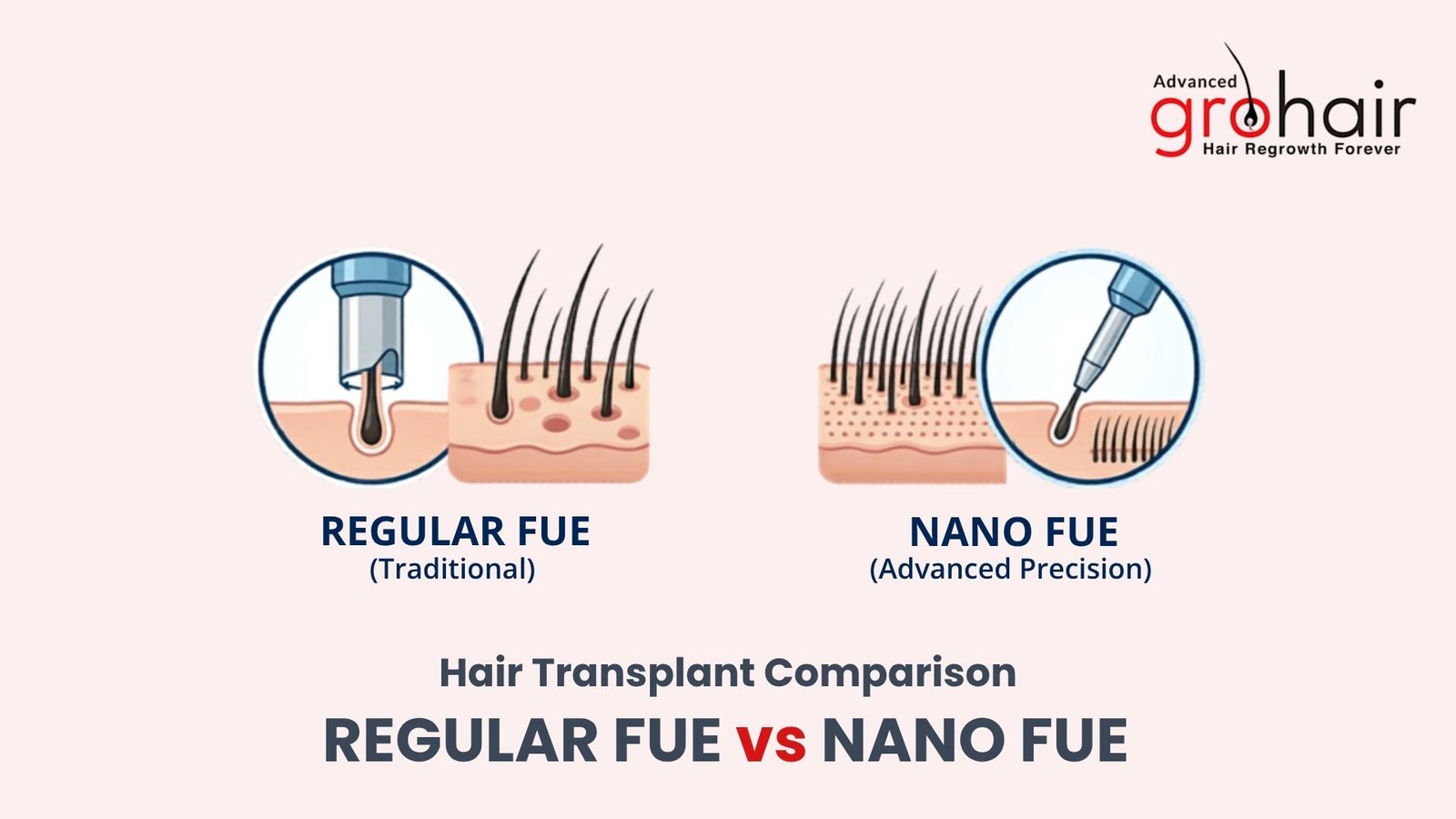
Choosing between NANO FUE and Regular FUE is one of the most important decisions you’ll make on your hair restoration journey. Pick the wrong technique for your hair type, and you risk poor graft survival, visible scarring, or results that simply don’t meet your expectations.
This guide breaks down both procedures with clinical precision so you can walk into your surgeon consultation fully informed.
Nano FUE uses ultra-fine punches (0.6–0.8mm) for precise follicle harvesting with minimal scarring, while Regular FUE uses standard punches (0.9–1.2mm) for faster, higher-volume sessions. Both are proven hair restoration techniques — the best choice depends on your hair type, graft needs, and surgeon expertise.
What Is Regular FUE?
Regular FUE (Follicular Unit Extraction) is the gold-standard minimally invasive hair transplant procedure that replaced the older strip (FUT) method in the early 2000s. It involves extracting individual hair follicles from the donor area and transplanting them into thinning or bald zones — leaving no linear scar.
How Regular FUE Works
- Consultation and hairline design
- Donor area preparation and local anesthesia
- Individual follicle extraction using a 0.9–1.2mm punch
- Graft sorting and storage
- Recipient site creation (small incisions)
- Transplanted hair follicle implantation
- Aftercare and recovery
Standard punch sizes (0.9–1.2mm) allow for faster extraction speeds, making Regular FUE particularly well-suited for large sessions requiring 3,000+ grafts. Manual, motorized, and even robotic punch variants are available, though surgeon skill remains the primary determinant of outcome quality.
What Is NANO FUE?
Nano FUE is an advanced evolution of standard FUE — not a fundamentally different category of procedure. The “nano” designation refers to the ultra-fine extraction punches used, typically 0.6–0.8mm in diameter. This smaller instrument allows for more precise follicle harvesting, reduced trauma to surrounding scalp tissue, and near-invisible dot scarring in the donor area.
The same basic workflow applies: extract follicles from the donor area, sort and store grafts, then implant into recipient sites. The key difference lies in how delicately those follicles are extracted. Nano instruments also allow for tighter graft placement during implantation, which enhances density and hairline naturalness.
Note: Some clinics combine nano-sized extraction with DHI (Direct Hair Implantation) using a Choi implanter pen for simultaneous placement — a hybrid approach that can further maximize graft survival and density for the right candidate.
NANO FUE vs Regular FUE: Key Differences
The table below captures the core clinical distinctions between both techniques.
Feature | NANO FUE | Regular FUE |
Punch Size | 0.6–0.8mm (ultra-fine) | 0.9–1.2mm (standard) |
Scarring | Near-invisible dot scars | Small dot scars (slightly larger) |
Graft Survival Rate | 90–98% | 85–95% |
Grafts per Session | 1,500–2,500 (slower) | 2,000–4,000+ (faster) |
Recovery Time | 5–7 days | 7–10 days |
Best For | Fine hair, hairline, diffuse thinning | Large bald areas, coarse hair |
Punch Size: Why It Matters More Than You Think
The 0.8mm threshold is clinically meaningful. Smaller punches create less tissue disruption per extraction site, which translates to faster healing and less visible scarring.
However, ultra-fine punches carry a slightly higher transection risk (accidental cutting of the follicle) if the surgeon lacks precision nano technique experience. The key takeaway: punch size alone doesn’t determine quality — surgeon expertise is the decisive factor.
Scarring: What to Actually Expect
Nano FUE produces sub-millimeter dot scars that are virtually invisible even when hair is worn very short. Regular FUE dot scars are slightly larger but still minimal — visible only if hair is shaved to skin level. Both represent a major improvement over FUT, which leaves a permanent linear scar across the back of the scalp.
Benefits of NANO FUE
- Precision and natural-looking results: Ultra-fine instruments allow more accurate graft placement, better angle control, and tighter hairline work — especially effective for hairline reconstruction and temple restoration.
- Minimal scarring and donor area preservation: Near-invisible dot scars allow all post-procedure hairstyle options, including very short cuts. The donor area is better preserved for potential future sessions.
- Faster recovery: Smaller wounds typically heal in 5–7 days; most patients return to desk work within 3–5 days.
- Higher graft survival rate: Reduced extraction trauma means more follicles arrive at the recipient site intact — estimated 90–98% survival under optimal conditions.
- Versatility: Effective for diffuse thinning, fine or fragile hair types, eyebrow transplants, beard restoration, and female pattern hair loss.
Benefits of Regular FUE
- Proven track record: Established since the early 2000s with thousands of peer-reviewed cases. Consistent, predictable outcomes in experienced hands.
- Higher-volume sessions: Standard punch sizes enable faster extraction, making Regular FUE ideal for patients who are significantly bald or need 3,000+ grafts in a single session.
- Better for coarse and thick hair: Larger punches provide a margin for the dimensional variation in curly or coarse follicles, reducing transection risk for these specific hair textures.
- Lower cost: Standard equipment means lower per-session overhead, with full sessions typically running $7,000–$18,000 — more accessible for patients with budget constraints.
Limitations of Each Method
NANO FUE Limitations
- Higher cost due to specialized instruments and slower extraction process
- Fewer grafts per session — not ideal for extensive baldness
- Requires a surgeon with advanced nano training; poor technique increases transection risk
- Not all clinics offering “nano FUE” use genuine nano-sized instruments — always verify
Regular FUE Limitations
- Slightly larger dot scars in the donor area
- More trauma to scalp tissue per extraction site
- Graft survival marginally lower than precision nano technique
- Less suitable for fine, thin, or fragile hair types
Recovery: Side-by-Side Timeline
Timeframe | NANO FUE | Regular FUE |
Day 1–3 | Mild redness, tiny scabs forming | More redness/swelling; slightly larger scabs |
Days 4–10 | Scabs fall naturally; minimal swelling | Scabs resolve; donor area heals |
Weeks 2–3 | Shedding phase begins (normal) | Shedding phase begins (normal) |
Month 3–6 | New hair growth begins | New hair growth begins |
Month 9–12 | Full natural-looking results | Final natural results achieved |
Recovery Tips for Both Methods
- Avoid aggressive hair washing for the first 72 hours
- Sleep with your head elevated for the first 3–5 nights
- Avoid direct sun, swimming, and intense exercise for 2–3 weeks
- Follow your surgeon’s aftercare protocol strictly — it directly impacts graft survival
Ideal Candidates: Which Technique Is Right for You?
Choose NANO FUE if you:
- Have fine, thin, or fragile hair that standard punches might damage
- Are focused on hairline refinement or temple restoration
- Want to wear very short hairstyles post-procedure
- Have a limited donor area and need maximum graft survival
- Are experiencing diffuse thinning (not just focal bald patches)
- Are a woman experiencing female pattern hair loss
Choose Regular FUE if you:
- Have extensive balding (Norwood IV–VII) and need 3,000+ grafts
- Have coarse, curly, or textured hair
- Are working with a tighter budget
- Are not concerned with wearing your hair extremely short
Conclusion
Choose NANO FUE if: fine/thin hair, hairline precision, minimal scarring priority, or diffuse thinning. Choose Regular FUE if: large bald area needing 3,000+ grafts, coarse hair, or budget constraints. In both cases: surgeon experience and technique matter more than instrument size alone.
Both Nano FUE and Regular FUE deliver natural-looking, long-lasting hair restoration results when performed by an experienced specialist. The technique is a tool — the surgeon’s skill, judgment, and understanding of your unique scalp anatomy are what ultimately determine your outcome.
Before committing to either method, ask to see before-and-after photos of patients with similar hair loss patterns, and request a thorough scalp and donor area assessment. A great consultation will always include an honest graft count projection tailored to your needs — not a sales pitch for any single technique.
Ready to find out which technique is right for you? Book a consultation with a certified hair transplant surgeon and bring this guide with you.
Advanced GroHair Clinic – Medical Team
Madurai
Last Updated: May 21, 2026
Frequently Asked Questions
Click to expand
1. Is Nano FUE better than Regular FUE?
+
Nano FUE excels for fine hair, hairline work, and minimal scarring. Regular FUE is more practical for extensive baldness needing large graft numbers. The best technique depends on your specific hair loss pattern, hair type, and aesthetic goals — always consult a qualified surgeon.
2. Does Nano FUE leave scars?
+
Yes, but they're tiny — sub-0.8mm dot scars that are virtually invisible even with very short hair. Regular FUE produces slightly larger dot scars. Neither leaves a linear scar; that is associated only with the older FUT (strip) method.
3. How many grafts can be done with each method?
+
Regular FUE allows 2,000–4,000+ grafts per session due to faster extraction speeds. Nano FUE sessions are typically limited to 1,500–2,500 grafts. Patients needing a high graft count may require multiple Nano FUE sessions.
4. Can women get Nano FUE?
+
Yes. Nano FUE is often the preferred option for women experiencing hair loss, including diffuse thinning and frontal hairline recession. The precision and near-invisible scarring make it appropriate for patients whose donor area may be visible in their typical hairstyles.
5. What is the success rate of Nano FUE vs Regular FUE?
+
Under optimal conditions with an experienced surgeon, Nano FUE achieves an estimated 90–98% graft survival rate. Regular FUE typically achieves 85–95%. Both depend heavily on surgeon skill, graft handling, storage, and post-operative aftercare.